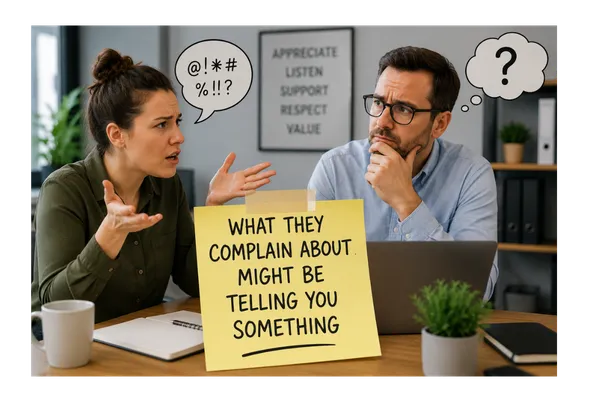
What Your Employees Complain About Might Be Telling You Something
One of the biggest lessons I've learnt over the years is this.
People don't always tell you what they need.
Sometimes they complain about it instead.
One employee might say:
"Nobody ever says thank you around here."
Another says:
"I'm always helping everyone else."
Someone else says:
"Nobody tells me what's going on."
On the surface, they sound like complaints.
But if you listen carefully, they're often clues.
Clues about what makes that person feel valued.
We All Feel Appreciated Differently

Some people simply want to hear:
"Thank you."
Others want someone to spend five uninterrupted minutes asking how they're doing.
Some value being trusted with responsibility.
Others appreciate practical support when they're under pressure.
The mistake many managers make is assuming everyone feels appreciated in the same way they do.
But appreciation isn't one-size-fits-all.
Listen Beyond the Complaint
Instead of asking:
"Why are they complaining again?"
Try asking:
"What are they really telling me?"
Sometimes the complaint isn't about the problem at all.
It's about a need that isn't being met.
When managers become curious instead of defensive, conversations change.
Relationships improve.
People begin to feel understood instead of dismissed.
It's About Understanding, Not Guessing
Of course, you can't assume every complaint reveals exactly what someone needs.
The best way to know is to ask.
But complaints can be the start of a conversation rather than the end of one.
Sometimes the biggest improvements in a workplace don't come from spending more money.
They come from understanding people a little better.
Beyond the Numbers
Every complaint tells a story.
Sometimes, if we're willing to listen, it also tells us what that person values most.
What's Your Story?
Every business has moments that stay with us.
The conversation that changed your thinking.
The employee who helped you see something differently.
The challenge that taught you an unexpected lesson.
Or perhaps a story that changed the way you lead your business.
I'm building a collection of real business stories because I believe the best lessons don't come from textbooks—they come from people.
If you have a story to share, I'd genuinely love to hear it.
Your experience could inspire a future Beyond the Numbers article and, with your permission, help other business owners realise they're not alone.
Share Your Story